

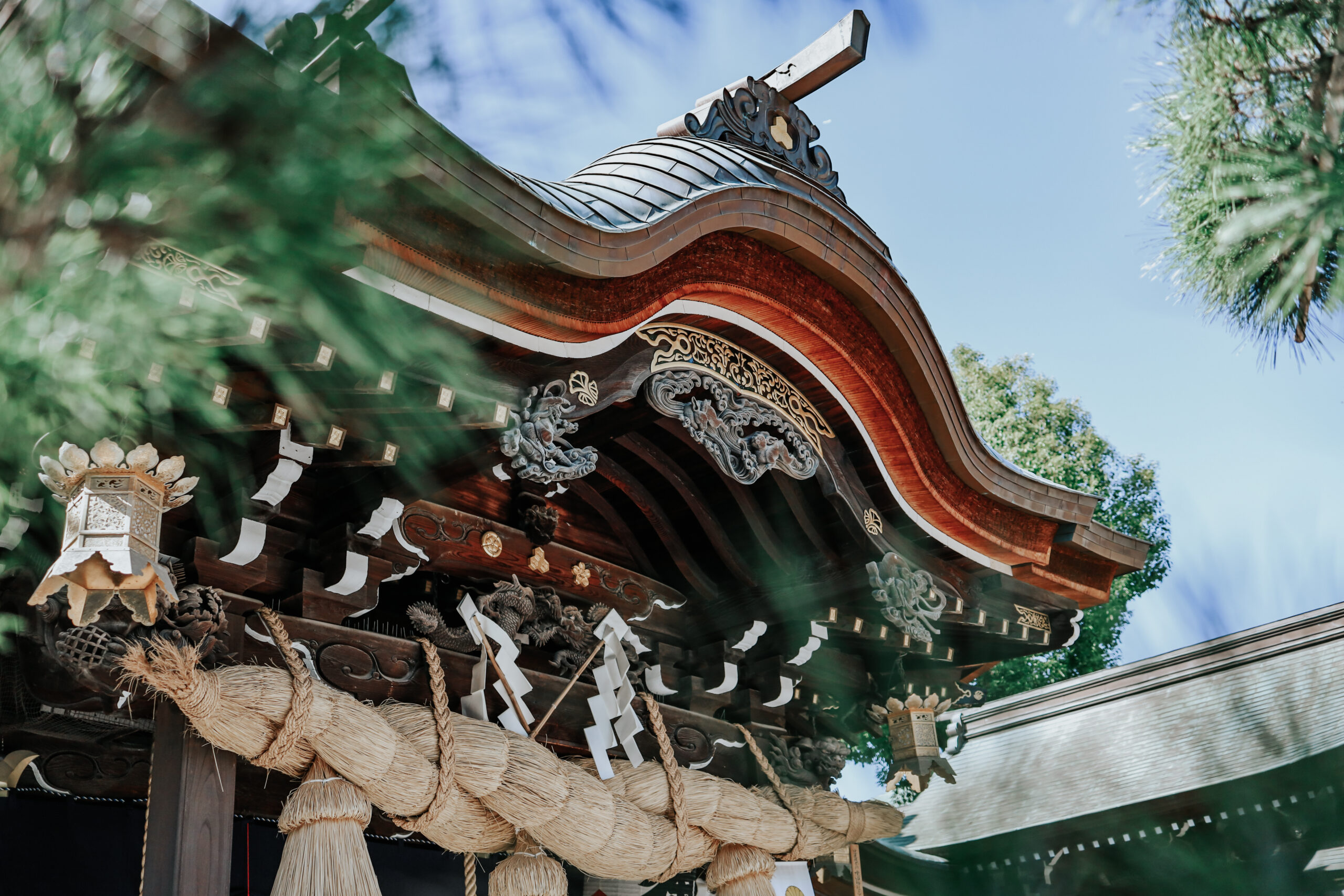
“Which prefecture in Japan has the most jinja (Shinto shrines)?”
Most people would be tempted to answer Kyoto, Nara, or perhaps Shimane, home of Izumo Taisha. The answer, however, is Niigata, on the Sea of Japan coast. According to the Agency for Cultural Affairs’ Survey of Religious Statistics (2023), Niigata Prefecture has 4,667 jinja. Hyogo, in second place, has 3,857, a gap of 810. These are numbers that put Niigata not just at the top, but in a league of its own.
So why did so many jinja come into being in Niigata, and why do they still remain today? There are two main reasons.
Reason 1: There Were Far More to Begin With, Thanks to New Rice Fields in the Edo Period
The story goes back to the Edo period (1603–1868).
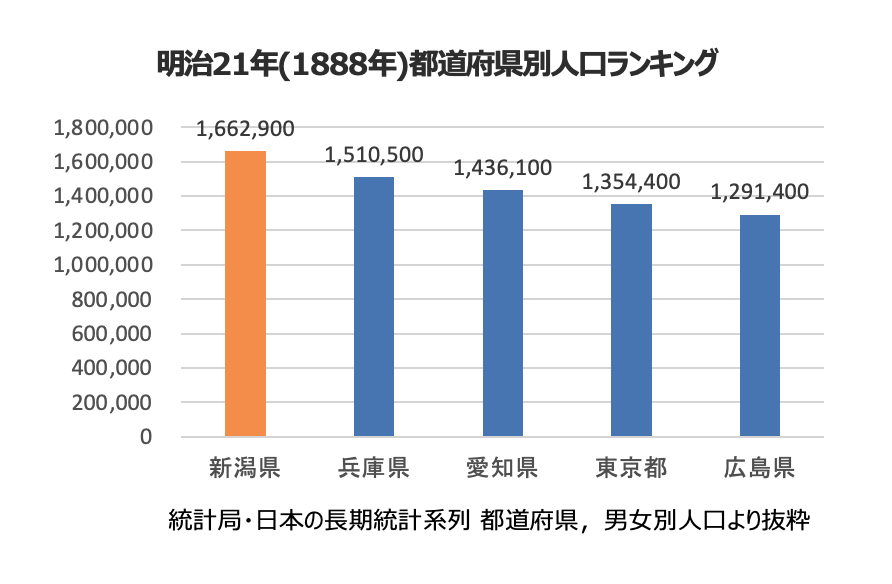
Look at Japan’s population by prefecture in 1888, and Niigata ranks first in the country, with more than 1.66 million people, well ahead of Hyogo in second place, with 1.51 million. What supported this large population was the development of new rice fields, pursued throughout the Edo period.
The vast wetlands of the Echigo Plain, which spreads across the center of Niigata, were cleared, and new villages, called shinden, sprang up one after another. Managing water and maintaining the paddies required enormous amounts of shared labor, and every settlement needed strong bonds among its people. And each time a settlement was born, a chinju-sama, the guardian kami of the village, was always enshrined there: as a source of strength, to pray for abundant harvests and protect the village from disaster, and as a place where people’s hearts could gather through matsuri (festivals). With every new settlement came a new jinja.
Isson issha: “one village, one jinja.” This principle created as many jinja as there were settlements in Niigata. In this land of thriving rice cultivation, people prayed to the kami for a good harvest in spring and gave thanks for the harvest in autumn. The jinja remained at the heart of farming and community life.
Reason 2: Local People Stood Firm Against a National Policy, Saying “We Cannot Do That”
In the Meiji era (1868–1912), the government launched a major policy: jinja goshi, the merger of jinja.
The Home Ministry set out to reorganize jinja nationwide, merging or abolishing small jinja and hokora (small roadside shrines) of uncertain origin, with the standard of “one jinja per town or village”: a single sonsha, or village jinja, for each administrative village. As a result, the number of jinja fell from about 190,000 in the early Meiji era to about 110,000 after the mergers. Some 40 percent of the jinja in Japan disappeared.
Places of faith rooted in local communities were lost in great numbers by a single government decision. Niigata, however, was different.
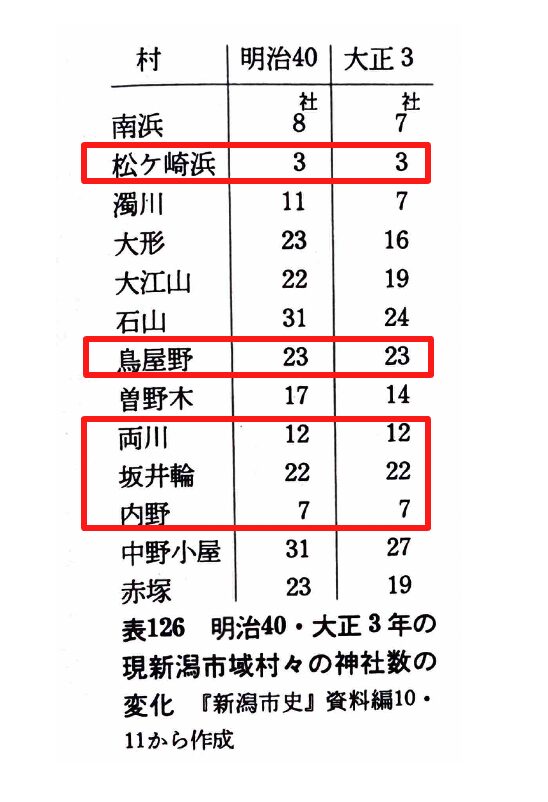
Records from villages in what is now Niigata City in the late Meiji era show that in five of thirteen villages, the number of jinja did not change at all. Local opposition was strong, and people protected their community’s guardian kami to the end. The merger policy that the national government pushed so hard was, to a considerable extent, toothless in Niigata.
History Lives in the Small Torii by the Roadside
To sum up, this research revealed two main reasons why Niigata has so many jinja.
- There were far more to begin with: New rice-field development in the Edo period rapidly increased the number of settlements and the population, and a jinja was born with each settlement, giving Niigata an exceptional number of jinja.
- National policy had little effect: While the Meiji government’s merger policy wiped out 40 percent of jinja nationwide, strong local resistance in Niigata meant that few were merged. Faith rooted in the community survived intact.
Walk through a village in Niigata today and you will come across small torii and hokora standing quietly by the roadside. They are not just part of the scenery. Each may be a remnant of a village that someone cleared in the Edo period. Or it may still stand there because local people stood firm against the Meiji government’s orders to merge, saying, “We cannot do that.”
When you visit Niigata, take a moment to stop not only at the famous jinja, but also at the small, nameless hokora. The prayers of the people who lived on that land are still quietly alive there.


