

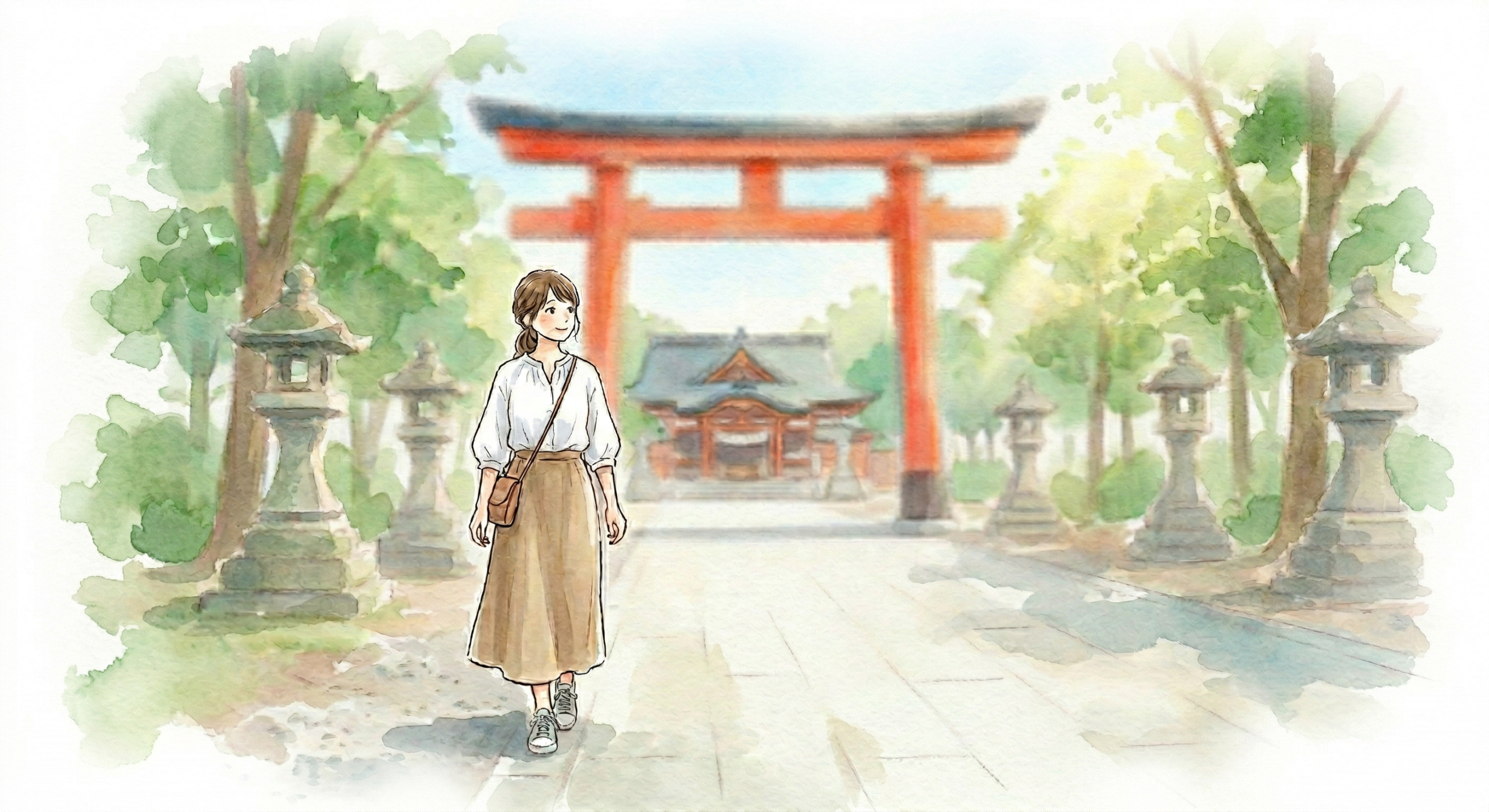
When you visit a jinja (Shinto shrine), the way you walk the approach path and the way you purify yourself with water each carry their own meaning. This article walks you through the etiquette, from passing beneath the torii gate to standing before the kami, along with the meaning behind each step.
目次
The Torii and the Sando: The Center Is the Path of the Kami

The torii marks the border between the sacred space of the jinja and the everyday world outside. Rather than walking straight through, pause and bow your head slightly to show respect to the kami before you enter.
As you walk along the sando, the approach path, pay attention to where you walk. The sando is the path that visitors take, but it is also the path of the kami. For this reason, avoid walking straight down its very center, called the seichu.
Some jinja also specify whether to keep to the left or to the right. At Ise Jingu in Mie Prefecture, for example, you keep to the left at the Geku (Outer Shrine) and to the right at the Naiku (Inner Shrine).
Temizu: Purifying Yourself with a Single Ladle of Water

Purity is very important in Shinto, and most jinja have a temizuya, a purification font, where you cleanse your hands and mouth before paying your respects. This act of purification is itself a Shinto rite. That is why you complete every step with a single ladleful of water, in the following order.
- Bow once in front of the temizuya.
- Take the ladle in your right hand and scoop up plenty of water.
- Rinse your left hand. (Keep some water in the ladle.)
- Pass the ladle to your left hand and rinse your right hand. (Keep some water in the ladle.)
- Pass the ladle back to your right hand, pour some water into your cupped left hand, and rinse your mouth with it. Do not touch the ladle to your mouth. Spit the water out at the base of the font, not into it.
- Rinse your left hand, which touched your mouth, once more. (Keep a little water in the ladle.)
- Finally, tilt the ladle upright so that the remaining water runs down and rinses the handle you were holding, then put it back where you found it. This is a courtesy so that the next person can pay their respects in comfort.
- Finish by bowing once.
Now your body and mind are purified, and you are ready to stand before the kami.
Paying Your Respects: Bow Twice, Clap Twice, Bow Once

The sando leads you to the haiden, the prayer hall. At larger jinja, the honden (main sanctuary) stands behind it, and most people pay their respects from outside the prayer hall. There is often an offering box and a bell rope at the front. Put in a few coins if you wish, and ring the bell if there is one, before you begin.
- Light bow: Bow lightly before the kami.
- Two bows: Straighten your back and bow deeply, to about 90 degrees, twice.
- Two claps: Bring your hands together at chest height, draw your right hand back slightly, and clap twice.
- One bow: Bow deeply, to about 90 degrees, once more.
- Light bow: Bow lightly as you leave.
If you have a prayer to offer, say it quietly after you clap.
Why You Draw Your Right Hand Back When You Clap
When you clap before the kami, do you press your palms together perfectly evenly? In fact, the more respectful way is to draw your right hand back slightly toward you. For the kami, the left side is regarded as the side of honor, so pulling your right hand back is a way of showing respect to the kami. Offsetting your right hand slightly also helps the clap ring out more clearly.
At first, there may seem to be a lot to remember. But listen to the tamajari, the fine gravel of the grounds, crunching with every step you take. Even that sound is a melody that purifies you and draws you closer to the kami. In the forest of a jinja, set apart from the noise of the town, the feeling of being purified in body and mind grows deeper when you arrive knowing what each gesture means.


